
What another season of "it's fine, it's just noise" actually costs
Here's the number that should end the debate: a worn cable or roller left alone usually turns a $150–$300 repair into a $600–$1,200 one, once you add a bent track, a cracked panel from a door that fell crooked, or an opener motor burned out trying to force a door that's binding. Nobody budgets for that in December. One spouse hears a squeak and shrugs. The other hears a warning. This is for both of you.
The two parts nobody looks at until they fail
Garage doors have a lot of visible moving parts — springs, track, the opener — but cables and rollers are the quiet ones. They don't get attention until they snap or seize, and by then the failure is loud, sudden, and sometimes dangerous.
Cables
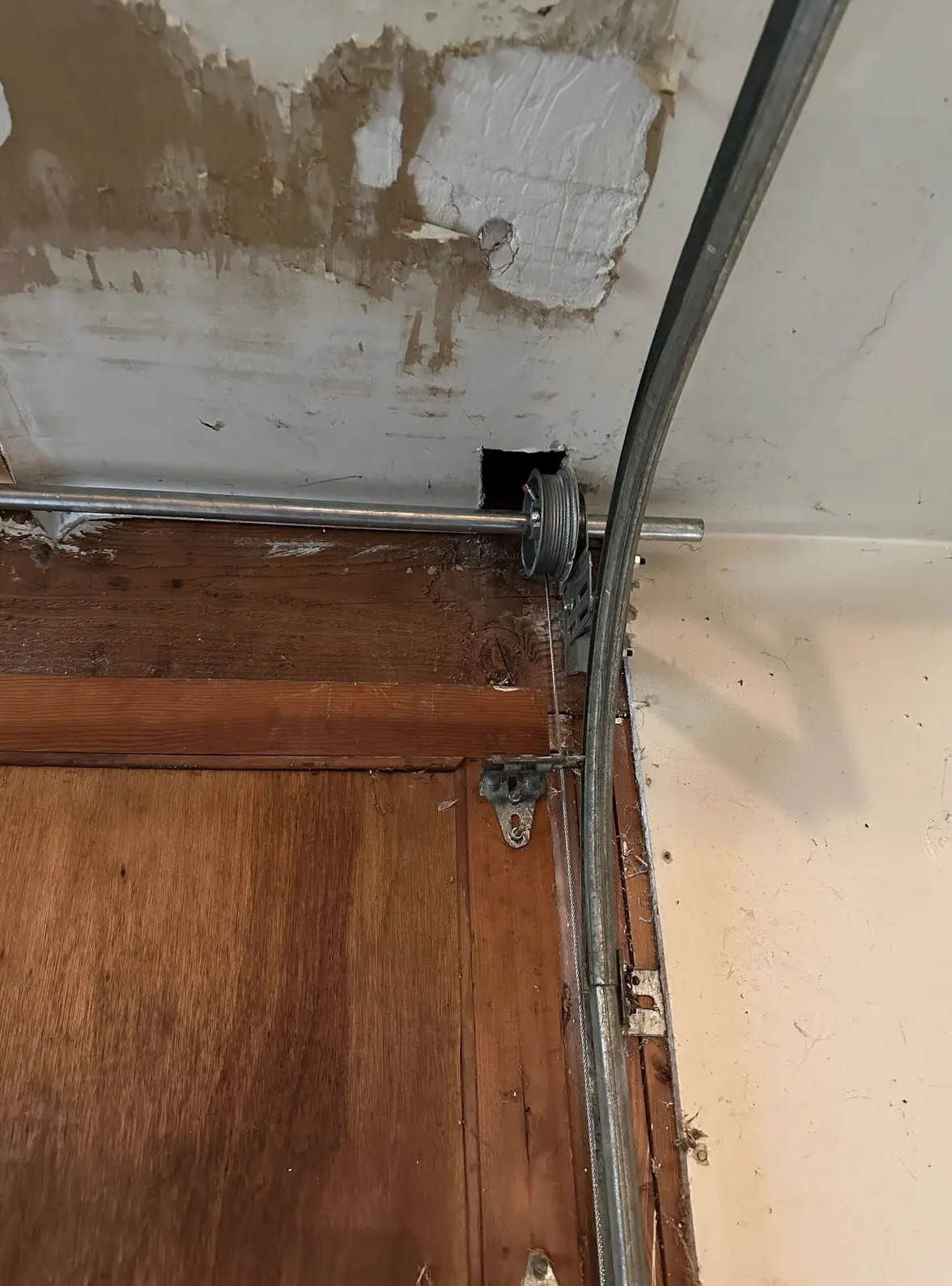
The cables run from the bottom corners of the door up to the drums near the springs. They carry serious tension — they're doing real work every time the door moves. A frayed cable looks like a tiny broken wire bristle sticking out, sometimes just one or two strands at first. That's not cosmetic. A cable under tension that's already lost a few strands can let go without warning, and when it does, that corner of the door drops. The door can come down crooked, jam in the track, or in a worst case drop hard enough to hurt someone standing nearby.
Rollers
Rollers are the wheels riding inside your track, and they take the daily wear of every open-and-close cycle. Worn rollers get flat spots, crack, or seize in their bearings. You'll hear it before you see it — a rhythmic thump-thump-thump as the door moves, or a grinding sound at one spot on the track every cycle. Left alone, a bad roller works itself loose, rides up out of the track, and the door comes off track entirely — usually at the least convenient moment, like right before you're leaving for work.
Why this part of Florida wears these components faster
Salt air near the coast and the humidity that sits over this area most of the year both speed up rust on cable strands and roller bearings. Rust doesn't just look bad — it pits the metal, which is exactly where fraying starts on a cable and where a roller bearing locks up. After a hurricane season of heavy afternoon downpours and humidity swings, doors that saw a lot of use (or sat in a swollen, slightly misaligned track) tend to show this wear right around now. Late fall, heading into the drier winter months, is actually a good window to catch it before next year's storm season puts the door back to work under load.
How to settle the argument without a service call
You can do a safe visual check yourselves:
- Look, don't touch, the cables. With the door closed, look at the cables near the bottom brackets for frayed strands, rust spots, or kinks. Do not grab or pull on them — they're under tension.
- Watch the door move. Stand back and open/close it once. Does one side lag, dip, or does the door look level as it travels? Uneven movement often means a roller or cable issue on one side.
- Listen for the thump. A steady thump at the same point in every cycle is a roller, not a lubrication problem.
- Don't lubricate your way out of it. Spray lubricant quiets a roller temporarily but won't fix a flat spot or a cracked bearing, and it won't do anything for a fraying cable.
If you see any fraying at all, that's the answer to the argument: it gets fixed now, not after it snaps.
When to call North Miami Garage Door Experts
If you've spotted frayed strands, rust on the cables, or a roller that thumps or grinds, that's exactly what our Garage Door Cable Repair visit is for — we replace cables in matched pairs so you're not back out here in six months for the other side. If you're not sure what you're looking at, our Garage Door Maintenance & Tune-Up covers a full inspection of cables, rollers, track alignment, and hardware, which is the easiest way to catch this before it becomes an emergency call.
Serving North Miami, North Miami Beach, Miami Shores, Aventura, Sunny Isles Beach, Biscayne Park, Opa-locka, and Miami Gardens — call us for same-day garage door service in North Miami, FL, and let's settle this before the next storm season puts it to the test.